We were talking around the office a couple of days ago about so called disruptive technologies. Steve Jobs and Bill Gates were masters at this. A disruptive technology is something that simplifies an existing technology and then out competes in the market. The i-phone and i-pad are great examples. The i-phone swarmed the cell phone market with the added plus of a convenient camera and other features. The personal computer came in to make computing available without a mainframe and remote access at a terminal. These inventions totally disrupted the normal way of conducting our personal and professional lives.
Blue Future Filters started in 2003 on work by myself dating back to the early 90s. My concept was clear. The wonderful technology responsible for saving so many lives- slow sand filtration, was practiced by large engineering firms for communities and cities through large scale construction projects costing millions of dollars. I came from a different background, more consumer and distribution oriented and thought if we could turn this from a custom engineered big project focus to a manufatured approach, we could standardize, bring costs way down, and enter a potential market.
Over the years we developed a series of standard models that complied with regulations for drinking water. By combining standard inexpensive models, we changed the scale of the projects. Suddenly a project manager didn't have to plan for a 50 year life with all the expense that entails. They could look at a few years knowing they could easily add on and expand as the need arose.
In this way, Blue Future, is continuing to disrupt the standard way of approaching treating surface water for safety for individuals and communities worldwide. We are bringing to market an old established technology in new skin creating a disruptive technology to the benefit of the world.

Tuesday, March 24, 2015

Sunday, February 15, 2015
AWWA Short School, Eugene, Oregon, March 10.
I will be traveling to Eugene, Oregon around March 9th-11 to teach a slow sand filter roughing filter session at the American Water Works Association Short School for operators. I'll probably travel down to northern California also. If you are in the vicinity and want to get together to talk about treatment options or arrange a site visit, let me know.
Monday, February 9, 2015
Providing Water

You just bought this piece of property, closed escrow two weeks ago. You know where you're going to put your house and the septic tank. You know there are some springs somewhere up the hill by those oaks. Now what?
You open the book Providing Water, a Practical Field Guide, and sit on a stump and start leafing through it. Says here that with gravity feed, you can have a complete water system including reliable treatment with no power, no chemicals, and no replacement cartridges. Hey, this would work for the local charity's project in the Philippines, since they don't don't have power at that village or the money to buy chemicals or a lot of replacement cartridges. Cool.
Hmm. How much water do I need? Find the chapter about assessing the need and you find out how much a person needs per day for themselves and other uses. That's interesting. Says here how much water you need depends on whether you have to carry the water, whether you have to irrigate, or wash a car, or have flush toilets. And here's a chart that shows how to calculate this.
OK, next. You march up the hill and find the Woodwardia ferns that the book says grow around water sources. Now what? The book describes your source and how to protect it with a good spring box. So far so good. You're feeling confident now that you will be able to layout the piping and deal with the pressure and air in the lines by following the principles outlined in the book. Wow, that's neat. You can reduce the pressure by putting a small tank halfway down the hill. Who woulda thought?
But, I may need to pump to a higher location. Oh, it describes pumping as well with choices- solar pumping, diesel, or from a reliable power grid.
You look at the drawings that detail what simple but reliable methods you can employ to remove pathogens, so your water is safe. You can manage this, it makes sense. And it's not rocket science.
The Book project
This project will produce a useful book based on my 20 plus years helping people all over the world source, treat, and provide water. The result will be a high quality document, ebook and paperback, which will include how-to, case studies, drawings, and illustrations. References will be provided for further study. To make this document maximally useful, I will reduce the jargon and use basic language, understandable by the lay person, do-it-yourselfer, development professional, disaster planner, and engineer. With this Field Guide, a person will be able to thoughtfully design and create a basic functional water system from source to tap using field tested techniques and reliable technologies. Topics include:
Table of contents
Introduction to rural water supply
Assessing the need
Assessing the water shed
Identifying sources- pros and cons
Developing a plan
Budget
Starting at the source
Treatment
Storage
Distribution
Testing
Community sustainability
Is it working after a year?
Wednesday, January 7, 2015
Great, Bill, but really? Appropriate Technology?
For context, some months ago I posted a blog post concerning how to select technologies in which I stated that there are fundamental requirements for any technology anywhere to be sustainable. These rules are summarized in the following graphic:

But it looks like they are thinking of this for developing country use. In this context it is a big negative. It will cease working when parts break, chemicals are not readily available, power fails, the technical expertise is not around, or the financial assets are not reliably available.
OK, so it quits working. So what. Probably financed by some sort of grants or loans from the North, No big deal...... Except for the end users.
If we are going to propose technologies that save lives and make lives better, it is a responsibility to make sure that we are proposing things that will work and be sustainable.
I have been a sad witness to many grand ideas originating in northern labs and think tanks in developing countries that looked great, but failed. When they fail, the people affected lose confidence in other proposals. Just last year, I was conversing with project directors for a drinking water project in India. We had come up with a solid, sustainable, appropriate solution using rainwater catchment and treatment. But, there was considerable resistance in the community. Why? Because previously, the same NGO had installed a high tech system that failed almost immediately, irreparably.
Gate's foundation is doing amazing work all over the world to reduce poverty and help give people a chance to live better. On this one, they are missing the mark.
In our zeal to save the world, we need to be thoughtful about what we propose and the long term effects of our work.
Saturday, November 15, 2014
2014 Governor's Emerging Trader of the Year- Blue Future

Thursday evening, I attended the annual World Trade Club of Washington'sTrader of the Year event to receive the 2014 Emerging Trader of the Year award and a beautiful crystal trophy. Below are my remarks at that time:
"I want to thank the World Trade Club for this prestigious
honor. We have had a joke around the office that one of these days, after years
and years of hard work and ups and downs, we would become an overnight success,
and this honor is certainly an indicator that we’re getting there. Much credit
goes to the vigorous state and federal trade agencies in Washington that have
provided Blue Future with invaluable help.
What does Blue Future
do? Blue Future makes and supplies our proprietary low tech water treatment
systems to customers throughout the US and, to date, to 22 countries. It started from my graduate work with Mayan
communities in the highlands of Chiapas, Mexico in the early 90s and arose from
a simple question.
“Is it
possible to provide a reliable and safe drinking water system that will work
for years, that takes water from surface sources, doesn’t require electricity,
or chemicals, or replacement cartridges, and can be maintained by local people?
“
The answer was a 200 hundred year old biological technology
called slow sand filtration, SSF. SSF removes high levels of bacteria, viruses,
and cysts, making water safe. But, there’s a hitch. Traditionally slow sand
filters are big, engineered, concrete and steel projects.
Blue Future solved this problem by putting the technology
into new materials. This allows for a manufactured solution that amortizes the
engineering over thousands of identical systems. We supply systems that treat 450 gallons per
day up to 200 gallons per minute, enough safe water for 31,000 people. The
result is Blue Future can provide US standard drinking water to any community,
anywhere in the world at reasonable cost.
Some of our projects over the years have included village
filters for Sumatra after the 2005 Tsunami, rainforest indigenous communities
in Peru, and for the last three years we have been supplying village sized
filters to Safe Water Network for communities around Lake Volta, Ghana with
funding from Newman’s Own Foundation and Hilton.
The bottom line for Blue Future is that 1 billion people in
the world do not have access to safe drinking water. Two million people die
every year from preventable water born disease. Blue Future’s vision is to
reduce these numbers, and I wish to thank you for your recognition of our
vision and efforts. "
Monday, September 8, 2014
Humboldt Bound
I'm heading to Humboldt in a week or so, my old stomping grounds. This time it is to deliver a slow sand filters system in Whitethorn, and to visit some folks along the way. If you are in Oregon, or that northern part of California, give me a nudge.
Saturday, August 9, 2014
Training

Slow sand and roughing filtration answer these issues very effectively.
If your organization would like to arrange a brown bag seminar or presentation on how these technologies can work for you and save you money, please contact me to discuss- hb@slowsandfilter.com
Tuesday, May 27, 2014
Revisiting Carrying Capacity

That is pretty much how we use it in animal husbandry- how many animals can we get onto a piece of land and have them survive from the available food. If we add suplimental feeding, then the carrying capacity goes up and we put more animals on the land. But there's a problem.
Recently I became aware of two facts here in Whatcom County, Washington, that are true in many areas. First, in looking at some aquifer maps, I saw that there are very high accumulations of Nitrate in groundwater around Lynden, a highly agricultural area here. The second fact was visual. Driving last week across the county I saw in several places huge impulse sprinklers spraying manure slurry onto the fields. This is a common practice as a means of getting rid of the manure from dairy operations and improving the fertility of the land, so it can produce good grass for the herds.
Do you see the problem? That manure is the source of the Nitrate in the groundwater. So, the land may be able to feed the animals, but it can't process the waste.
Which leads to the conclusion that carrying capacity should not just be about how many animals you can feed on a piece of land, but also how can the land process the waste products of the animals without destroying water quality.
Another way to look at this is to look at true costs of agriculture. The true cost would include removing the nitrate from the water that the animals contributed.
One way or another, we pay. If we use present land use definitions of carrying capacity, we pay for the treatment to remove the pollutants. If we restrict the number of animals to more accurately represent carrying capacity, the price of meat will go up. We pay with tax, or we pay at the store. Of course, the meat producers would prefer not to talk about it. If they don't have to pay a true cost of production, then they look like they are selling a good value, and the costs to fix the damage are managed by those all time favorite bad guys- the government.
If meat prices reflected the true cost, we probably wouldn't buy so much, which is a worry for the producers, but would benefit our aquifers, and for that matter our hearts.
Mass production of meat is a little like the fossil fuels business. there are lots of subsidies, tax breaks, and market tricks that camouflage the true cost. At the very least, we should push back the veils to see what our meat consumption really costs us in dollars and environmental impacts.
Tuesday, April 8, 2014
Cherokee Nation Slow Sand Filter
Posting pictures and descriptions as they happen, scroll down for earlier photos.
September 29th, 2014. The chart below shows turbidity data following start up of the filter and covers about the first 30 days with measurements by Hach 1720e turbidimeters every 15 minutes. The upper curve is filter 1, the lower is filter 2. Filter 1 may have higher turbidity because it was the filter where sand was blown in resulting in lots of dust. Both filters trending downwards as we would expect and at this time are in the upper .1s. Constant flow and clean gravel result in start ups like this. The minor oscillations are interesting and may be a result of pump cycling on the supply effecting water level in the tanks, or finished water effecting back pressure on the control valve. There is also a longer term oscillation at work here.
August 12th, 2014. Filters have been online for a couple of weeks now. Turbidity in filtered water continues to go down, latest around 2.5 NTU. Filters producing steady 65 gpm for the community. We expect chlorine demand to be significantly declining as well compared to how the system worked before the slow sand filters went in. That means reduced Trihalomethanes.
July 30th, 2014. Filter is online producing water of acceptable quality. I did a quick calculation on the cost per gallon of this project over the expected life of the system and it comes out to $.00065 gallon. That's a pretty good return on investment for the community.
July 7th, start up week. After a few delays dealing with media issues, sand was loaded in the filter tanks using super sacks. A previous effort using a blower resulted in a major dust storm in the building! The good news is, sand was loaded and water filled the tanks for commissioning.
 |
| Kenwood slow sand filter turbidity, the first month. |
August 12th, 2014. Filters have been online for a couple of weeks now. Turbidity in filtered water continues to go down, latest around 2.5 NTU. Filters producing steady 65 gpm for the community. We expect chlorine demand to be significantly declining as well compared to how the system worked before the slow sand filters went in. That means reduced Trihalomethanes.
July 30th, 2014. Filter is online producing water of acceptable quality. I did a quick calculation on the cost per gallon of this project over the expected life of the system and it comes out to $.00065 gallon. That's a pretty good return on investment for the community.
July 7th, start up week. After a few delays dealing with media issues, sand was loaded in the filter tanks using super sacks. A previous effort using a blower resulted in a major dust storm in the building! The good news is, sand was loaded and water filled the tanks for commissioning.


After initial filling to flood the media, influent flow shifts to above the sand, first hitting splash plates to dissipate energy and not dig into the sand. Harrowing inlets are the duller white forms center top of the picture. These are used for cleaning the sand when necessary. Initial turbidity measurements were .6 and .7, already in compliance with surface water treatment standards.
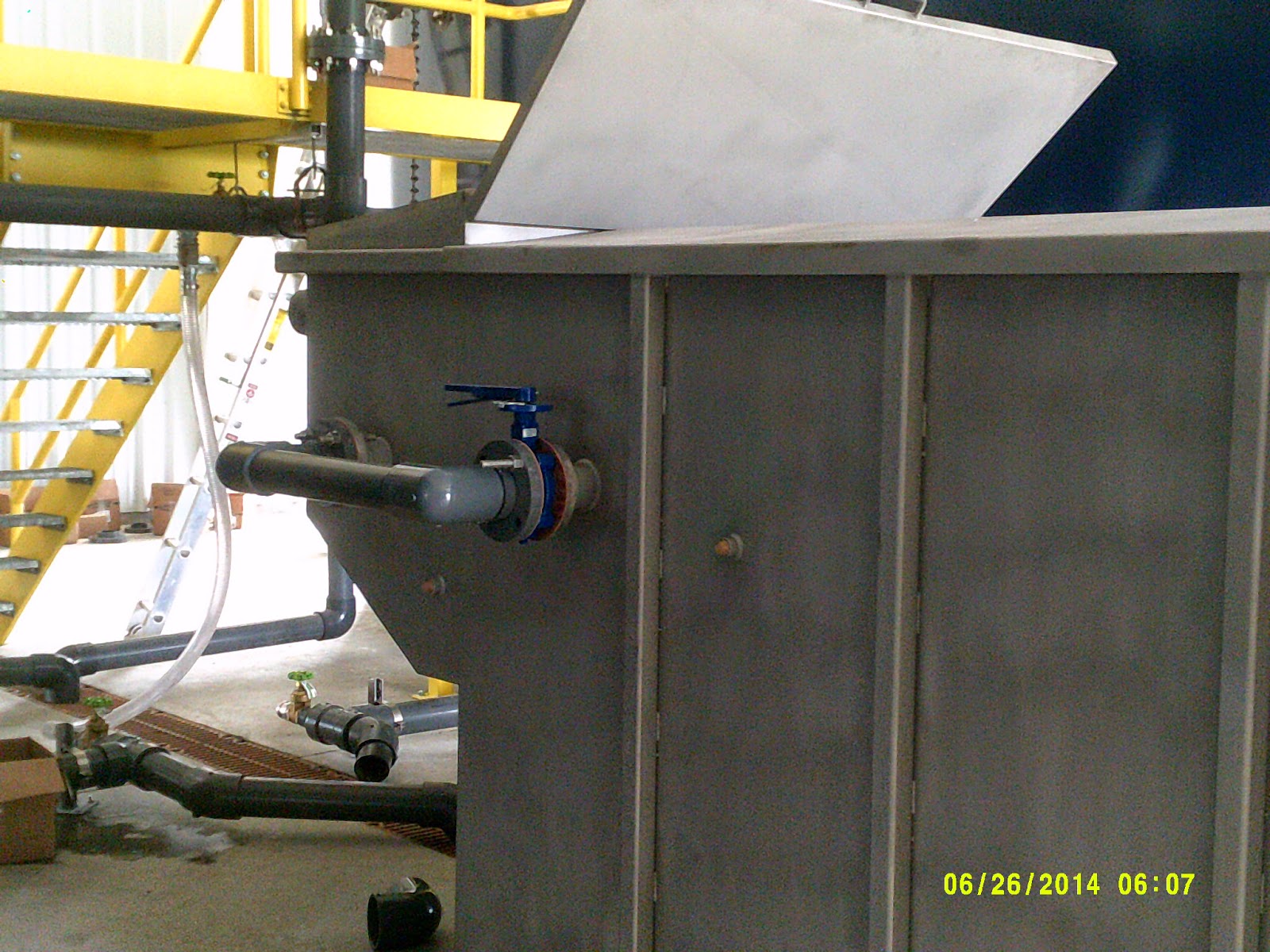
June 27. Side view of the newly installed stainless steel overflow weir/clearwell tank. This tank is placed between the filter tanks and protects the filters from being inadvertently dewatered as well as being a constant head device which maintains constant flow, adjusting for headloss in the filter. The 3" valve controls flow through the filter. A valve on the opposite side of the tank controls flow through the other filter.

June 27th. Prior to loading the sand, the gravel layers are covered with water and chlorinated to sanitize. Careful treatment of the gravel is critical to successful slow sand filter start up.

The Building goes up around the tanks, which are already loaded with gravel and have underdrain installed.

4/29 A view from the water tower showing the completed tanks with gravel and underdrains nearing completion. Next, the building will be built around the filters. When that is completed, the weir/clearwell tank, and plumbing will be completed and sand will be loaded. Getting close folks. Stay tuned!

4/22 Course gravel went in first, then the slotted underdrain pipe and connecting manifold. The gravel was washed multiple times to make sure that clean water will come out of the filter when it is started up.

4/17 Looking inside the tank with protective mastic applied and stainless steel nozzles for the inlet, outlet, harrowing, and overflow. Next- the gravel and underdrain piping going in.

4/16. here are the two filter tanks almost completed, The underdrain laterals are stacked in the foreground. Since this photo was taken, the a sealer was applied to the inside of the tanks to protect them from the gravel media. Next step will be placing course gravel in the bottom of the tank, followed by assembly of the slotted PVC underdrain piping, then the rest of the gravel layers. The brown tee shape is a drain system. Later, a stainless steel clearwell/weir tank, being fabricated, will be installed between the two filters. Stay tuned!

Why build from scratch when you can go off the shelf?
Stay tuned for more pictures!
Saturday, January 25, 2014
Drought, now what?

When I lived on the Sonoma coast of California during the mid 90s to 05, conditions were dry. Some planned communities could only get water permits if they built large reservoirs, and only took water from streams during high water in the winter. Some long time residents on wells were seeing their well water declining due to rapid vineyard development sucking the aquifers dry. Recently, a large food producer in Santa Rosa was having trouble getting a permit because the city wanted a lot of money to supply the water and sewer.
And now, we see California in a super drought. Northern California has 8% of normal snow pack. Stories from the Sonoma coast are of January with everything brown, when the hills should be green from December rains. Predictions are that this situation will likely become the new normal.
California residents and planners will have to take lessons from India and Africa about capturing and storing water when it is available for use when it's not.
A few years ago. I did some research and design for planned communities which could not use ground water or water from nearby ponds or streams. All water use had to be derived from captured rainwater. The above picture shows the result. massive underground reservoirs built from space age structural plastics, covered with permeable geo fabrics and permeable landscaping materials. Beautiful and functional year round supply. In India, a return to traditional rainwater catchment is happening. Small retention dams are built in swales and stream beds. The object is not to make ponds, but to slow the water down so it sinks into the soil and recharges the aquifers instead of running off to the sea.
Industry is going to have to forget about sewer systems, and focus on "0" discharge and recycle all their water and adjust their thinking about how they use water.
Arguing about water rights and rates is not the answer. A paradigm shift in how water is viewed, captured, and utilized is necessary from the large scale user all the way to the homeowner.
To read about progress in India that may relate to problems here-http://www.hydratelife.org/?p=1765&goback=%2Egde_79990_member_5806975627458260994#%21
Blue Future Filters rainwater filter systems
Thursday, January 23, 2014
The Latest Scam- Beware!
A couple of days ago, I received an email from someone named
Bob Wilson
4002 Ronson Court,
San Diego, California 92111
United States
URGENTLY requesting information to order effluent filters. Usually when someone just wants to order product without any questions, I figure it's a scam especially if they want to pay by credit card. There are other clues, but I don't want to alert the scammers to their own vulnerabilities. This has happened before to us. Fortunately we saw through the veil before we processed an order. This one was a bit more sophisticated. I emailed the guy back asking for details of his application. He responded by asking for an link to see the units. A reasonable request. I sent him a link for our roughing filters. He replied "yes" and wanted a price on one of the units we offer. I sent him that price FOB.
Then came the long email saying he wanted me to get a quote for shipping using a particular shipping company in the Netherlands and he wanted a grand total so he could pay by credit card.
Now I new it was a RAT. I Googled the above mentioned name and address and got the following link-
link to others contacted by this scam
At this page, you will see a sad story of people trying to accommodate this person who is trying to scam them.
This would not have gone any further for us in any case, because we would require more verification before processing an order such as this, but nevertheless, I'm sure others, eager to make a sale in a bad economy, may fall for this.
Be forwarned. If it sounds too good to be true, start checking around.
Monday, December 16, 2013
Slow Sand Filters for Leyte??

The recent typhoon carnage in the Philippines was a replay for me of the earthquake in Haiti. Once again, the ensuing chaos resulted in an international effort to rush much needed food, water, and shelter into an area devastated. Once again, I have urged getting community sized slow sand filters placed into remoter areas so that not only would people have water for the next days or weeks, but for years to come after the disaster relief efforts have waned.
This time was different though from Haiti in several important ways.
- For several years, Blue Future has supplied 1800 gpd filters to Mindanao. This has resulted in not only awareness of these systems there, but also a group of people who understand how they work and how to install them.
- Blue Future has an excellent partner in Manilla who can supply the filters, loaded with media, and delivered ready to go to villages in need, virtually anywhere in the Philippines.
With these human and logistical elements in place, there is the capacity to get dozens of these water treatment solutions to those in need, not just for today, but for years to come of safe water availability.
We can get 20 filters, delivering 5 gallons per day per person, for over 6,000 people for $26,000. But, as is always the case, we need organizations to step forward and take on this initiative. If your organization wants to make a long term difference for the people of the Philippines now, please get in touch to discuss.
Friday, October 11, 2013
Humanitarian Efforts are like Beer and Yogurt
Embarking on a humanitarian effort in developing countries is a little like my first experiences with beer and yogurt. When I was a kid, I'd see these TV ads with a local bodybuilder talking about Yogurt and what a great thing it was- so creamy, so healthy. Beer ads always showed someone having a good time with friends, or taking a refreshing break on a hot day. I couldn't wait to try these divine products. Then I did. Yogurt was horrible. Sour, mostly. Beer was worse- bitter and loamy. Yuck. Any person is faced with a choice at this point- swear off em forever, or readjust your expectations. I ended up adjusting my views of both yogurt and beer, and enjoy them to this day.
My first experience with a humanitarian project in a developing country was with a group travelling to Nicaragua during the war there in the 1980s. We were all pumped up to go develop a health clinic in a town sorely in need of one. Our first casualty was at the airport in San Francisco. Dawning on people what we were doing and getting ourselves into, we had a defection at the gate. Once in Nicaragua, things were seemingly OK, at first. The people treated us really well. We worked hard and partied hard. A certain amount of tourist diarrhea and cock roaches as big as my shoes, but hey. About a week into our visit, several of us went into the capital Managua to buy paint. When we got back to our town, it was in an uproar. An ambush by the Contras, US supported rebels fighting the Sandinista regime, had attached the mayor's car on her way back from a neighboring town. She was fine, but our crew wasn't. The reality of what we were doing sunk in hard. The next day,a large contingent was headed for the airport home. I stayed, by the way.
Almost without exception, people I have met over the last 25 years start with a fairly pure and hopeful vision of what it will be like bringing people safe water and sanitation. Given enough money and technology, we can save the world. Then comes reality. Language barriers and misunderstandings. Community groups with conflicting goals and agendas. Technologies not well suited for uses. Lack of qualified people to maintain things. Lack of community participation and buy-in.
This is where that old yogurty bitter taste becomes evident. Then you must choose- abandon your efforts, or adjust and get to work. The one thing for sure is water and sanitation interventions in developing countries are never simple in-and-out propositions. To be effective and sustainable, these projects require, careful planning, intense listening, innovation, and a sustained effort, in order to make sure that they are still effective for the next generation.
My first experience with a humanitarian project in a developing country was with a group travelling to Nicaragua during the war there in the 1980s. We were all pumped up to go develop a health clinic in a town sorely in need of one. Our first casualty was at the airport in San Francisco. Dawning on people what we were doing and getting ourselves into, we had a defection at the gate. Once in Nicaragua, things were seemingly OK, at first. The people treated us really well. We worked hard and partied hard. A certain amount of tourist diarrhea and cock roaches as big as my shoes, but hey. About a week into our visit, several of us went into the capital Managua to buy paint. When we got back to our town, it was in an uproar. An ambush by the Contras, US supported rebels fighting the Sandinista regime, had attached the mayor's car on her way back from a neighboring town. She was fine, but our crew wasn't. The reality of what we were doing sunk in hard. The next day,a large contingent was headed for the airport home. I stayed, by the way.
Almost without exception, people I have met over the last 25 years start with a fairly pure and hopeful vision of what it will be like bringing people safe water and sanitation. Given enough money and technology, we can save the world. Then comes reality. Language barriers and misunderstandings. Community groups with conflicting goals and agendas. Technologies not well suited for uses. Lack of qualified people to maintain things. Lack of community participation and buy-in.
This is where that old yogurty bitter taste becomes evident. Then you must choose- abandon your efforts, or adjust and get to work. The one thing for sure is water and sanitation interventions in developing countries are never simple in-and-out propositions. To be effective and sustainable, these projects require, careful planning, intense listening, innovation, and a sustained effort, in order to make sure that they are still effective for the next generation.
Thursday, September 19, 2013
Assessing the Need
Frequently, people call me and ask for a solution to their water problem. Many times, the first thing they say is they have so much flow from their spring or well, as if that was enough information to design a water system. It's a little like saying "I have $250 to buy gasoline, what kind of car should I buy?" Obviously there are a number of questions that must be answered before you buy a car. How much does it cost? What do I need a car for? Do I need to haul materials? Do I have kids or large pets? Do I have parking? Do I have enough income to pay the payments and lots of gasoline for a big engine.
It's the same with a water system. The wise way to design a water system is from the use back to the source. Such questions as:
It's the same with a water system. The wise way to design a water system is from the use back to the source. Such questions as:
- How many people are going to use this water?
- Do they have water to their homes, or do they have to carry it? (makes a big difference in how much needs to be produced)
- What is in the water? Bacteria? Giardia, Iron, Hardness?
- Does there need to be water for growing plants or livestock?
Once these questions are answered, you can calculate how much water you need. Then you can look at your supply to see if there is enough. If there is, you can start the next series of questions- the design questions.
- Do you have gravity feed or do you need to pump?
- Do you need to treat the water for contaminants?
- Do you need to store water to even out the demand?
If there is not sufficient water available for your needs, you need to find an additional source, or cut back you requirements.
Then you can start looking at specific features such as placement of equipment and what kind of equipment. You can calculate pipe sizes and storage volumes. You can design wells or spring boxes.
The point is, without knowing your needs requirements in terms of quantity and quality, it doesn't matter how much water you have available. You may be buying a Honda Civic, when you need a Ford-150. Or vice versa.
(this is one subject that will be covered in detail in the book- Providing Water)
(this is one subject that will be covered in detail in the book- Providing Water)
Wednesday, August 14, 2013
Container Shipping Slow Sand Filters
It's surprisingly affordable to ship community slow sand filters overseas by container. We can get six 8' diameter slow sand filters capable of treating 43,000 gallons per day into this 20' container. Total shipping to Africa from Bellingham Washington was about $4,000
Here's how we do it..

Here's how we do it..

 |
| First, we bundle and load the lids |
 |
| We load the first filter up to the edge of the container opening |

Then, we load the next paper cup fashion by sliding it into the first tank. A bit trickier than it looks. We repeat this until all six tanks are loaded.
 |
| Finally, we add the control tanks with all fittings and documentation enclosed |
 |
| Unpacked and placed into operation in this African community after travelling thousands of miles across oceans. |
Friday, July 19, 2013
Filters in Mindanao


After I got off the phone, I contacted folks I have worked for before in Peru and the Philippines and got a quick reply.
If you haven't followed it, Mindanao, the large island in the south of the Philippines has had devastating typhoons in recent years. Theses storms wipe out infrastructure and create torrents of polluted water and accompanying disease. Some filters Blue Future has supplied in the past were the only sources of safe water for whole neighborhoods.
Blue Future works with local organizations and with a company in Manila who supplies us with the tanks using our design and components.
I recently received the pictures shown here of the neighborhood and some residents who just took possession of the new 1800 gallon per day slow sand filter that Thomas provided.
Friday, June 28, 2013
Offending the Spring
or, how to keep spring production continuing.
Springs are like teenagers. They need encouragement, nurturing, and minimal push-back to keep them from running away. It's important when you want to develop a spring to not inhibit it's flow in any way. As we all know, water finds its own way. If you push water, it goes around you. If you dam up a spring to collect the water, it will find another route to come out or disappear entirely. It is also important to safeguard the spring water from surface contamination, kind of like parental controls on the world wide web.
There are a couple of common ways to develop a spring. The most common way is to build a spring box. This is usually out of concrete, but any variety of other materials could be used so long as it can be secured from contamination. Water enters the spring box from a porous surface into the hill from which the spring emerges. This can be made by building in perforations in the concrete, or building a block wall with big openings between blocks. The important thing is to make sure that the outlet from the spring box is set at such a height that water does not accumulate above the spring source which would cause back pressure.
The other common method is to drive a perforated pipe into the hill and spring and capture water that way. Concrete grout is used to seal the pipe where it enters the hillside. Horizontal well drillers put these in all the time and they are quick and clean.
It's also important that you put an overflow in the piping after the spring box or spring pipe. This allows for times when you aren't using all the spring water, but don't want water to back up into the spring box.
Helpful hint. Oftentimes springs can be located by the presence of woodwardia ferns
Springs are like teenagers. They need encouragement, nurturing, and minimal push-back to keep them from running away. It's important when you want to develop a spring to not inhibit it's flow in any way. As we all know, water finds its own way. If you push water, it goes around you. If you dam up a spring to collect the water, it will find another route to come out or disappear entirely. It is also important to safeguard the spring water from surface contamination, kind of like parental controls on the world wide web.
There are a couple of common ways to develop a spring. The most common way is to build a spring box. This is usually out of concrete, but any variety of other materials could be used so long as it can be secured from contamination. Water enters the spring box from a porous surface into the hill from which the spring emerges. This can be made by building in perforations in the concrete, or building a block wall with big openings between blocks. The important thing is to make sure that the outlet from the spring box is set at such a height that water does not accumulate above the spring source which would cause back pressure.
The other common method is to drive a perforated pipe into the hill and spring and capture water that way. Concrete grout is used to seal the pipe where it enters the hillside. Horizontal well drillers put these in all the time and they are quick and clean.
It's also important that you put an overflow in the piping after the spring box or spring pipe. This allows for times when you aren't using all the spring water, but don't want water to back up into the spring box.
Helpful hint. Oftentimes springs can be located by the presence of woodwardia ferns
Monday, June 3, 2013
Rope Pumps

The book, Providing Water, contains many such innovations appropriate to developing countries. Drawing by Xan Blackburn (www.xans-art.com)
Wednesday, May 22, 2013
Providing Water, Book Update
Nine days left on the Kickstarter project- to assemble a Field Guide for Providing Water. I receive calls regularly asking various questions as diverse as spring design to how much storage is needed, and everything in between. This book will be a summary of my experience over the last 25 years in the US and with groups in 20 countries. This book allows people working in developing countries, as well as rural Americans, to find solutions without having to reinvent the wheel. It is also one of the very few books that emphasizes appropriate technology. A few more backers of this project will get it off the ground and flying.
Providing Water, A practical Field Guide
Providing Water, A practical Field Guide
Friday, May 17, 2013
Climate change and Water Scarcity

And why we need to change the way we design for water and wastewater
A recent opinion piece in the Santa Rosa Press Democrat talks about Amy's foods needing to expand and the City of Santa Rosa wanting a $31 million water and wastewater permit fee. Amy's, one of my favorite packaged food companies, is expanding rapidly and needs a larger manufacturing plant which they anticipate will require 12 million gallons a month of water and resulting wastewater. The city says they have to expand water and wastewater facilities for this kind of demand, and want Amy's to help pay for this. Back in the last century, battles like this would rage, companies would move, cities would back down, and the taxpayers would be in an uproar.
But here's the thing. This isn't 1950, nor even 1980. We are in an age of increased population and demands on water as well as requirements to clean up discharges into precious water resources. Then, you pile on top of that climate change, rising sea levels, increasing salt water intrusion, and it is necessary that we rethink our water use and wastewater production radically.
A couple of years ago, I was hired to do research into methods of providing water and dealing with waste streams for a planned community with the following rules- no aquifer depletion, no discharge of wastewater, and rainwater to be the sole source of water.
You'd be surprised to know how much you can do with those constraints. Capturing rainwater through porous materials and storing in huge underground self supporting structures, complete recycling of wastewater leaving only solid residues, using biological treatment systems that don't have high energy or chemical requirements. It's all available now.
If Amy's were to use these approaches, they could not only reduce their usage, and therefore their bill, but also not strain existing water resources, and help the planet. And I bet it would cost less that $31 million.
Of course, this also requires major changes in how the regulatory process works, and a big change in the engineering mindset that relies on last century technologies and approaches to 21st century problems.
Subscribe to:
Posts (Atom)