Tuesday, April 8, 2014

Cherokee Nation Slow Sand Filter

Posting pictures and descriptions as they happen, scroll down for earlier photos.

September 29th, 2014. The chart below shows turbidity data following start up of the filter and covers about the first 30 days with measurements by Hach 1720e turbidimeters every 15 minutes. The upper curve is filter 1, the lower is filter 2. Filter 1 may have higher turbidity because it was the filter where sand was blown in resulting in lots of dust. Both filters trending downwards as we would expect and at this time are in the upper .1s. Constant flow and clean gravel result in start ups like this. The minor oscillations are interesting and may be a result of pump cycling on the supply effecting water level in the tanks, or finished water effecting back pressure on the control valve. There is also a longer term oscillation at work here.
Kenwood slow sand filter turbidity, the first month.

August 12th, 2014. Filters have been online for a couple of weeks now. Turbidity in filtered water continues to go down, latest around 2.5 NTU. Filters producing steady 65 gpm for the community. We expect chlorine demand to be significantly declining as well compared to how the system worked before the slow sand filters went in. That means reduced Trihalomethanes.

July 30th, 2014. Filter is online producing water of acceptable quality. I did a quick calculation on the cost per gallon of this project over the expected life of the system and it comes out to $.00065 gallon. That's a pretty good return on investment for the community.

July 7th, start up week. After a few delays dealing with media issues, sand was loaded in the filter tanks using super sacks. A previous effort using a blower resulted in a major dust storm in the building! The good news is, sand was loaded and water filled the tanks for commissioning.
 Loading and leveling sand.
 After filling the tanks from below, to eliminate air, water passes to the overflow weir and then the clearwell. Now comes the tuning to make adjustments for maximum performance, such as adjusting float rod arm length.
After initial filling to flood the media, influent flow shifts to above the sand, first hitting splash plates to dissipate energy and not dig into the sand. Harrowing inlets are the duller white forms center top of the picture. These are used for cleaning the sand when necessary. Initial turbidity measurements were .6 and .7, already in compliance with surface water treatment standards.
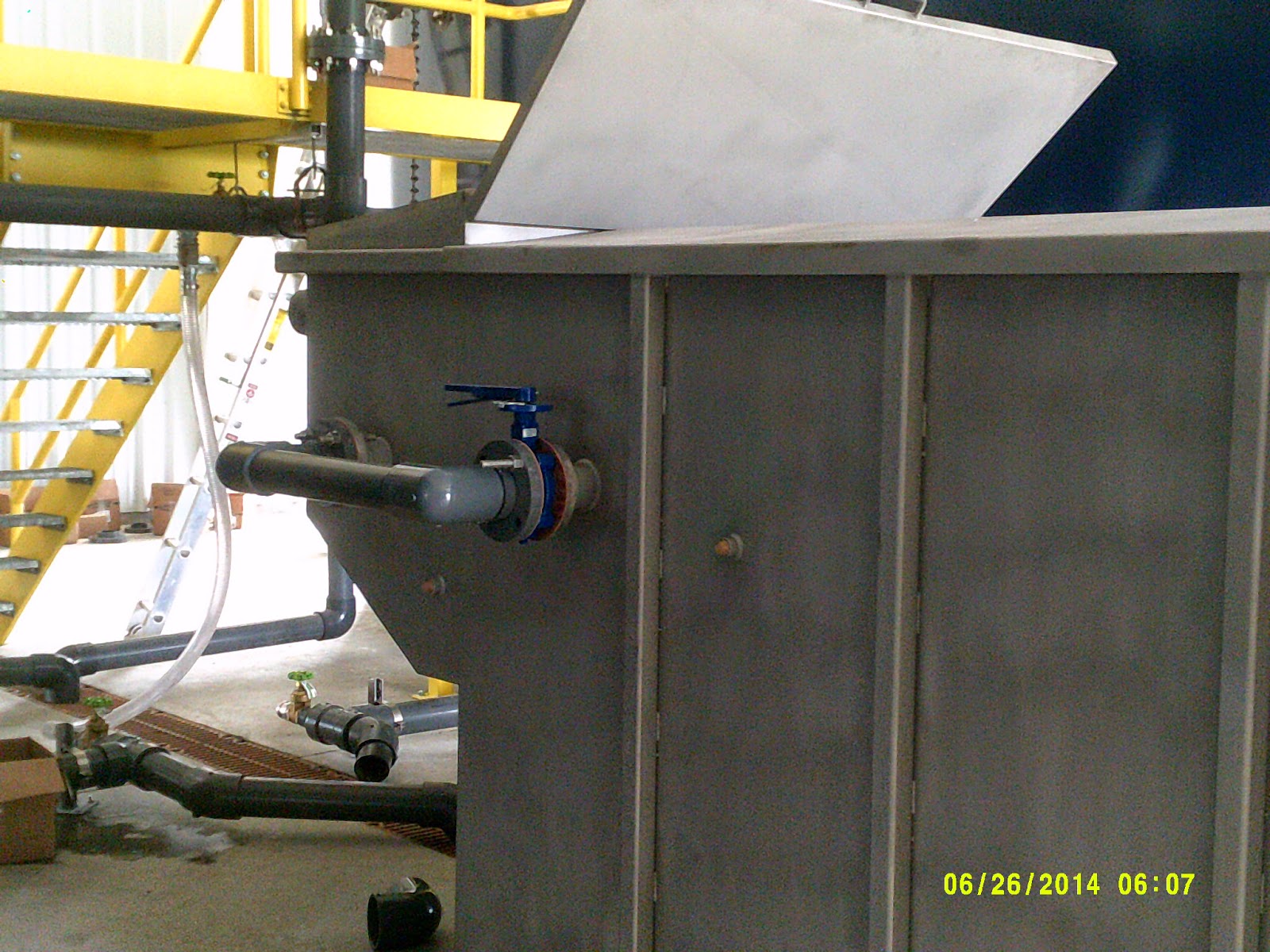
June 27. Side view of the newly installed stainless steel overflow weir/clearwell tank. This tank is placed between the filter tanks and protects the filters from being inadvertently dewatered as well as being a constant head device which maintains constant flow, adjusting for headloss in the filter. The 3" valve controls flow through the filter. A valve on the opposite side of the tank controls flow through the other filter.

June 27th. Prior to loading the sand, the gravel layers are covered with water and chlorinated to sanitize. Careful treatment of the gravel is critical to successful slow sand filter start up.

The Building goes up around the tanks, which are already loaded with gravel and have underdrain installed.


4/29 A view from the water tower showing the completed tanks with gravel and underdrains nearing completion. Next, the building will be built around the filters. When that is completed, the weir/clearwell tank, and plumbing will be completed and sand will be loaded. Getting close folks. Stay tuned!
4/22 Course gravel went in first, then the slotted underdrain pipe and connecting manifold. The gravel was washed multiple times to make sure that clean water will come out of the filter when it is started up.

4/17 Looking inside the tank with protective mastic applied and stainless steel nozzles for the inlet, outlet, harrowing, and overflow. Next- the gravel and underdrain piping going in.
4/16. here are the two filter tanks almost completed, The underdrain laterals are stacked in the foreground. Since this photo was taken, the a sealer was applied to the inside of the tanks to protect them from the gravel media. Next step will be placing course gravel in the bottom of the tank, followed by assembly of the slotted PVC underdrain piping, then the rest of the gravel layers. The brown tee shape is a drain system.  Later, a stainless steel clearwell/weir tank, being fabricated, will be installed between the two filters. Stay tuned!
This is exciting. The floor and starter rings for two 100 gpm slow sand filters using glass coated steel tanks were poured last weekend. The tank is being erected this week and soon the underdrain, gravel and sand will be installed. Culminating a three year effort, this state of the art slow sand filter will be accomplished at a fraction of the cost of conventional built in place concrete tanks. This is possible because of Blue Future's modular approach to slow sand filters, and the use of modern materials and methods.
Why build from scratch when you can go off the shelf?
Stay tuned for more pictures!

Saturday, January 25, 2014

Drought, now what?


When I lived on the Sonoma coast of California during the mid 90s to 05, conditions were dry. Some planned communities could only get water permits if they built large reservoirs, and only took water from streams during high water in the winter. Some long time residents on wells were seeing their well water declining due to rapid vineyard development sucking the aquifers dry. Recently, a large food producer in Santa Rosa was having trouble getting a permit because the city wanted a lot of money to supply the water and sewer.

And now, we see California in a super drought. Northern California has 8% of normal snow pack. Stories from the Sonoma coast are of January with everything brown, when the hills should be green from December rains. Predictions are that this situation will likely become the new normal.
California residents and planners will have to take lessons from India and Africa about capturing and storing water when it is available for use when it's not.

A few years ago. I did some research and design for planned communities which could not use ground water or water from nearby ponds or streams. All water use had to be derived from captured rainwater. The above picture shows the result. massive underground reservoirs built from space age structural plastics, covered with permeable geo fabrics and permeable landscaping materials. Beautiful and functional year round supply. In India, a return to traditional rainwater catchment is happening. Small retention dams are built in swales and stream beds. The object is not to make ponds, but to slow the water down so it sinks into the soil and recharges the aquifers instead of running off to the sea.

Industry is going to have to forget about sewer systems, and focus on "0" discharge and recycle all their water and adjust their thinking about how they use water.

Arguing about water rights and rates is not the answer. A paradigm shift in how water is viewed, captured, and utilized is necessary from the large scale user all the way to the homeowner.

To read about progress in India that may relate to problems here-http://www.hydratelife.org/?p=1765&goback=%2Egde_79990_member_5806975627458260994#%21

Blue Future Filters rainwater filter systems


Thursday, January 23, 2014

The Latest Scam- Beware!


A couple of days ago, I received an email from someone named

Bob Wilson
4002 Ronson Court,
San Diego, California 92111
United States

URGENTLY requesting information to order effluent filters. Usually when someone just wants to order product without any questions, I figure it's a scam especially if they want to pay by credit card. There are other clues, but I don't want to alert the scammers to their own vulnerabilities. This has happened before to us. Fortunately we saw through the veil before we processed an order. This one was a bit more sophisticated. I emailed the guy back asking for details of his application. He responded by asking for an link to see the units. A reasonable request. I sent him a link for our roughing filters. He replied "yes" and wanted a price on one of the units we offer. I sent him that price FOB.

Then came the long email saying he wanted me to get a quote for shipping using a particular shipping company in the Netherlands and he wanted a grand total so he could pay by credit card.

Now I new it was a RAT. I Googled the above mentioned name and address and got the following link-


link to others contacted by this scam


At this page, you will see a sad story of people trying to accommodate this person who is trying to scam them.

This would not have gone any further for us in any case, because we would require more verification before processing an order such as this, but nevertheless, I'm sure others, eager to make a sale in a bad economy, may fall for this.


Be forwarned. If it sounds too good to be true, start checking around.


Monday, December 16, 2013

Slow Sand Filters for Leyte??


The recent typhoon carnage in the Philippines was a replay for me of the earthquake in Haiti. Once again, the ensuing chaos resulted in an international effort to rush much needed food, water, and shelter into an area devastated. Once again, I have urged getting community sized slow sand filters placed into remoter areas so that not only would people have water for the next days or weeks, but for years to come after the disaster relief efforts have waned.
This time was different though from Haiti in several important ways.

  • For several years, Blue Future has supplied 1800 gpd filters to Mindanao. This has resulted in not only awareness of these systems there, but also a group of people who understand how they work and how to install them.
  • Blue Future has an excellent partner in Manilla who can supply the filters, loaded with media, and delivered ready to go to villages in need, virtually anywhere in the Philippines.
With these human and logistical elements in place, there is the capacity to get dozens of these water treatment solutions to those in need, not just for today, but for years to come of safe water availability.

We can get 20 filters, delivering 5 gallons per day per person, for over 6,000 people for $26,000. But, as is always the case, we need organizations to step forward and take on this initiative. If your organization wants to make a long term difference for the people of the Philippines now, please get in touch to discuss. 


Friday, October 11, 2013

Humanitarian Efforts are like Beer and Yogurt

Embarking on a humanitarian effort in developing countries is a little like my first experiences with beer and yogurt. When I was a kid, I'd see these TV ads with a local bodybuilder talking about Yogurt and what a great thing it was- so creamy, so healthy. Beer ads always showed someone having a good time with friends, or taking a refreshing break on a hot day. I couldn't wait to try these divine products. Then I did. Yogurt was horrible. Sour, mostly. Beer was worse- bitter and loamy. Yuck. Any person is faced with a choice at this point- swear off em forever, or readjust your expectations. I ended up adjusting my views of both yogurt and beer, and enjoy them to this day.

My first experience with a humanitarian project in a developing country was with a group travelling to Nicaragua during the war there in the 1980s. We were all pumped up to go develop a health clinic in a town sorely in need of one. Our first casualty was at the airport in San Francisco. Dawning on people what we were doing and getting ourselves into, we had a defection at the gate. Once in Nicaragua, things were seemingly OK, at first. The people treated us really well. We worked hard and partied hard. A certain amount of tourist diarrhea and cock roaches as big as my shoes, but hey. About a week into our visit, several of us went into the capital Managua to buy paint. When we got back to our town, it was in an uproar. An ambush by the Contras, US supported rebels fighting the Sandinista regime, had attached the mayor's car on her way back from a neighboring town. She was fine, but our crew wasn't. The reality of what we were doing sunk in hard. The next day,a large contingent was headed for the airport home. I stayed, by the way.

Almost without exception, people I have met over the last 25 years start with a fairly pure and hopeful vision of what it will be like bringing people safe water and sanitation. Given enough money and technology, we can save the world. Then comes reality. Language barriers and misunderstandings. Community groups with conflicting goals and agendas. Technologies not well suited for uses. Lack of qualified people to maintain things. Lack of community participation and buy-in.

This is where that old yogurty bitter taste becomes evident. Then you must choose- abandon your efforts, or adjust and get to work. The one thing for sure is water and sanitation interventions in developing countries are never simple in-and-out propositions. To be effective and sustainable, these projects require, careful planning, intense listening,  innovation, and a sustained effort, in order to make sure that they are still effective for the next generation.

Thursday, September 19, 2013

Assessing the Need

Frequently, people call me and ask for a solution to their water problem. Many times, the first thing they say is they have so much flow from their spring or well, as if that was enough information to design a water system. It's a little like saying "I have $250 to buy gasoline, what kind of car should I buy?" Obviously there are a number of questions that must be answered before you buy a car. How much does it cost? What do I need a car for? Do I need to haul materials? Do I have kids or large pets? Do I have parking? Do I have enough income to pay the payments and lots of gasoline for a big engine.

It's the same with a water system. The wise way to design a water system is from the use back to the source. Such questions as:

  • How many people are going to use this water?
  • Do they have water to their homes, or do they have to carry it? (makes a big difference in how much needs to be produced)
  • What is in the water? Bacteria? Giardia, Iron, Hardness?
  • Does there need to be water for growing plants or livestock?
Once these questions are answered, you can calculate how much water you need. Then you can look at your supply to see if there is enough. If there is, you can start the next series of questions- the design questions. 
  • Do you have gravity feed or do you need to pump?
  • Do you need to treat the water for contaminants?
  • Do you need to store water to even out the demand?
If there is not sufficient water available for your needs, you need to find an additional source, or cut back you requirements. 

Then you can start looking at specific features such as placement of equipment and what kind of equipment. You can calculate pipe sizes and storage volumes. You can design wells or spring boxes. 

The point is, without knowing your needs requirements in terms of quantity and quality, it doesn't matter how much water you have available. You may be buying a Honda Civic, when you need a Ford-150. Or vice versa.

(this is one subject that will be covered in detail in the book- Providing Water)


Wednesday, August 14, 2013

Container Shipping Slow Sand Filters

It's surprisingly affordable to ship community slow sand filters overseas by container. We can get six 8' diameter slow sand filters capable of treating 43,000 gallons per day into this 20' container. Total shipping to Africa from Bellingham Washington was about $4,000
Here's how we do it..
First, we bundle and load the lids


We load the first filter up to the edge of the container opening


Then, we load the next paper cup fashion by sliding it into the first tank. A bit trickier than it looks. We repeat this until all six tanks are loaded.
Finally, we add the control tanks with all fittings and documentation enclosed
Unpacked and placed into operation in this African community after travelling thousands of miles across oceans.